I love Power Rangers. I realize this is the most ordinary think a child of the 90's can possible say, but it's true. I love how it's all at once batshit insane and yet charmingly simplistic. I love how it keeps reinventing itself season after season. I love the way it's brought cultures together, introducing an entire generation of American youth to Japanese tokusatsu. But most of all, I love the childlike sense of fun and optimism it inspires in me every time I see it.
The feeling I'm describing is called "nostalgia", a concept I'm sure you're all familiar with. It's become something of a buzzword in recent years, and has been a frequent influence on our culture since any of us can remember. It's such a natural human instinct, the desire to capture that feeling of simplicity and ignorant bliss that characterized our childhoods. So we latch onto anything, any memory that might trigger some semblance of that feeling: a favorite toy or game, a familiar song, an old friend, etc. But more broadly recognized and shared are cultural moments that touched and inspired entire generations: famous historical events certainly, but also media like films and tv shows. These things can not only make us feel like kids again, but bring us together in a mutual wistful remembrance of times gone by. Nostalgia is a wonderful thing.
So why are we so damned ashamed of it?
Actor and MMA fighter Jason David Frank, known to Power Rangers fans the world over as the Green Ranger and a breakout favorite of the show, said in a recent interview that he is "talking to Saban*" about the possibility of making a spinoff film focusing on his character. It would supposedly be PG-13, implying a somewhat darker tone than Power Rangers generally has, and he spoke of making the Green Ranger "the Wolverine of Power Rangers."
With all respect to my childhood hero, none of this sounds anywhere close to a good idea. Put aside for a moment the fact that the entire point of Power Rangers is teamwork; complimentary skills, powers, and equipment always succeeding where the efforts of one always fail, so a solo Power Ranger anything is about as un-Power Rangers a concept as you can get. Spinoffs and/or stronger focuses on characters who become unexpectedly popular almost never end well and lead to overexposure. The aforementioned Wolverine is a prime example of this. But beyond that, the idea that such a film would need to be PG-13 just depresses me, because it's demonstrative of a prevailing attitude with regard to reviving nostalgic properties: the idea that they need to be darker.
For some reason, while nostalgia is something we all share, often openly, it's also something we have this bizarre need to distance ourselves from. Going back and watching your favorite episodes of Transformers is okay, but only if you do so "ironically". After all, Transformers was a kid's show, and you're not a kid anymore. So to maintain your vacuous misunderstanding of "maturity", you can only experience nostalgia in a sarcastic, detached fashion. "Harr dee harr! Look at how silly these cartoons are! Can you believe I used to love this shit!? Stupid childlike awe! Harr dee harr!"
So as a result, when said shows get modern updates, fans, having long since grown up, like to think that their beloved childhood classics have somehow grown up with them. They want something that they can appreciate with the same sincere wonder that they had when they were younger. But since they now feel accessing their inner child is somehow beneath them, the answer is to dress those old "kiddie" shows in the hollow trappings of what current you thinks of as "maturity": darker colors, gritty realism, grayer moralities, and brooding self-importance. "Superman's not just for kids anymore! He just snapped a guy's neck! So it's totally okay for me to still be into him!"
Look, I understand the mindset. I've been there. The inception of the name "Joshua the Anarchist" was entirely due to my being a miserably mopey teen way too obsessed with Heath Ledger's Joker for all the wrong reasons when I came up with it. Not five years ago I too was craving something exactly like what JDF is proposing, a dark, gritty vision of Power Rangers. I know about taking yourself too seriously, about mistaking pessimism for realism**. So I say this with the greatest sympathy: Get the fuck over yourself.
Have you forgotten what attracted you to these things in the first place? It wasn't that they were "edgey" or "dark" or "mature", it was they were were fun and light-hearted. Is not the whole point of nostalgia to remind yourself of happier times, when the world was less complicated and you were less cynical? Are you really going to continue to let your obsession with the trappings of maturity to the exclusion of its substance continue to pollute and distort your childhood memories? Growing up isn't about leaving the things you love behind. It's about expanding your mind and taking responsibility for your actions.
Do not misunderstand me to mean that stories and franchises should never change or evolve. Batman has been swinging back and forth between comedy and seriousness for the better part of a century now. Stagnation is the enemy of any franchise, and adaptability its cure. So by all means, rethink and reevaluate your favorite childhood stories. But don't ever lose sight of what made that story worth telling a second time to begin with.
*And let's be very clear here: "talking" could me anything from "we are actually having official meetings about this as a serious potential movie" to "I mentioned the idea to one guy and he said 'yeah, we'll talk later'". At this point the whole prospect of this project ever getting off the ground doesn't seem terribly likely. I'm not upset about this news because I'm afraid I'll ever actually have to see the damn thing. I'm upset because the idea is so symptomatic of a larger, prevalent attitude.
**to once again borrow the phrase from Flex Mentallo that just never stops being relevant.

Showing posts with label The Geek Chorus. Show all posts
Showing posts with label The Geek Chorus. Show all posts
Thursday, October 3, 2013


Wednesday, September 4, 2013
The Geek Chorus: What We Can Learn from "The World's End"
The World's End is by far the most unexpectedly brilliant movie of the year. I expected it to be good. After all, it is an Edgar Wright film, and Edgar Wright can always counted on for great comedy combined with amazingly complex scripting and editing and a strong emotional core. So I was ready for The World's End to be the best comedy of the year, and it was. What I wasn't expecting was that it would also turn out to be the best science fiction movie of the year. More than just a heartfelt character comedy, The World's End somehow also turned out to be the most thought provoking sci-fi film I've seen since Christopher Nolan's Inception. It's hard, intellectual stuff, and like Inception it takes an old, well-explored concept and looks at it through an uncompromising lens no one has ever dared look through before. It absolutely blew my mind to the point that I've been able to focus on little else since it came out. It'll likely end up being my favorite movie of 2013, and I just have to share with you all why. Obviously spoilers follow, so if you haven't see it yet, what is wrong with you? Go see it now! Then see it a few more times, then come back.
The World's End starts off as such a simple concept: one man's struggle with his addition. But then it ingeniously expands on that concept to such extremes that it encompasses the whole of humanity. Gary King, who we first see as an adult attending a AA meeting, defies any and all outside efforts to fix his problems. This isn't because he's happy being a lonely alcoholic, but rather because he simply can't stand not being in charge of his own life. "They told me when to go to bed," he wails miserably. Regardless of what you think of Gary's decisions, it's hard not to sympathize with the humiliation and infantilization that comes from being a grown man who can't even choose his own bed time.
But just when you think this movie, which seems to be about little but the self destruction of one stubborn alcoholic with some sci-fi on the side, has reached it's climax...everything changes. The movie shows its hand, and reveals itself to be about so much more than you imagined. It takes the idea of one person's stubborn refuses to be dictated too, even if it is for his own good, and applies it to the entire human race. I admit, the first time around this threw me a bit. It seemed an almost random and disconnected turn of events. But on a second viewing, it all clicked for me when I noticed the use of the words "enable" & "intervention" during Gary's confrontation with the Network. The movie ends as it began: with, as Gary describes is "a bunch of people in a circle talking about how awful things have got." The first time it was a circle of recovering alcoholics, the second a circle of alien androids. Both groups genuinely want to help Gary and make him a better person, both are mostly uninterested in whether Gary actually wants their help or not, and both find their efforts rejected.
Now on the one hand, the idea being raises here, that it's is our flaws that make us human and to try and perfect us would be to rob us of our humanity, is a very old idea that has been put forth by many films before. Gary himself reminds us of the old expression "to err is human." The film's genius comes in how it answers this question. When Gary, and by extension the human race, reject the Network's offer of galactic citizenship, their decision comes at a price. They don't just get to go back the status quo. The film realizes that to reject any and all control is to reject the very concept of civilization. And thus, civilization ends.
This uncompromising honesty is what I find so unique and striking about The World's End. Gary's defiant declaration of "We are the human race, and we don't like being told what to do!" is one I've heard many different versions of before. Freedom is an enticing notion. It's one we're very fond of, as it's been romanticized many times in fiction. So often, in fact, that we often forget that freedom has a downside to it. Because freedom, while nice to have, benefits only the individual at cost of the greater whole. The more free we are as individuals, the less cooperation is possible as group. As a race we humans are capable of amazing things. We have cured disease, built machines that can traverse the globe in hours, and connect us to each other in seconds. As a race, we set foot on the fucking moon. As a lone individual, we are capable of substantially less.
We have gotten very good over the years at demonizing ideas like collectivism, globalism, or anything that deemphasizes the individual in service of a larger group. This is largely due to said ideas having been repeatedly misused to horrifying effects by various dictators and regimes. Control scares us. We don't like giving up our freedoms, any of our freedoms, for fear on what those we give them too might do with them. It's a scary world, and sometimes we feel like we can't trust anyone but ourselves. We like to think of ourselves and individuals first and part of something bigger than ourselves second if at all. But in doing so, we severely limit our potential as a species. Everyone bemoans the slow erosion of our privacy and freedoms as we venture further into the Information Age, without stopping to consider that maybe such things are just the natural consequences of coming together as a species.
When Gary declares (with a quote for Animal House, appropriately enough) independence from the Network's control on behalf of mankind, at first it is met with the usual triumphant celebration. But suddenly as the entire world starts imploding around them, Gary and his friends are confronted with the horrific realization of what they've done. They've saved the world from invaders, but at the cost of our way of life.You don't get to live completely free of control and still have governments to run things, public services to help & protect you, free unlimited access to information, or even running water pumped to your house. Those things only come with mutual cooperation, which would mean submitting to the will of something larger than yourself.
The question is then posed by The World's End: what do you value? Freedom or progress? Are you really willing to live with the consequences that freedom, real & total freedom, would bring? Are perhaps the rewards of scientific and social progress worth the price of some of your liberties? On the other hand, are you willing to risk losing your individual self for the greater good of the species?
These are hard questions that the film pulls no punches with and I honestly don't know how to answer them. 5 or so years ago, I would've answered right away. Back then I was still an angry, self important teenager, a hardcore libertarian who thought he knew everything. But I was much less thoughtful then, and my thinking now couldn't be more different. Now I honestly don't know if, had I been there, I would've sided with Gary and chosen freedom, or if I'd have been like the "Shifty Twins" and chosen progress. Is humanity, in the context of the film, to be commended for sacrificing everything for their independence, or is the fact the the Network had to mulch so many of us more indicative of something wrong with us than something wrong with them? The film remains indifferent in its final judgement, leaving it up to us to decide whether or not Gary made the right call. It's not an easy question for me to answer, but in trying it brings up so many questions about the nature of humanity and our relationship with each other. "To err is human," Gary King says to us, "so, err..."
Tuesday, October 23, 2012
The Geek Chorus #6: Why Batman Must Never Kill
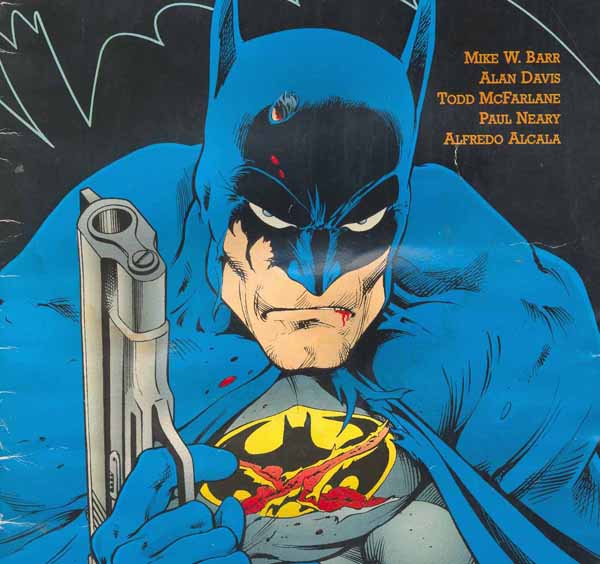
This is an issue that's been stewing in my head for sometime. It's was almost brought to fruition by that trailer for that horrible Batman fan film Suffocator of Sins, but the internet more than did my job for me on pointing out what a blight on humanity that was. I thought perhaps I had worried over nothing. Perhaps everyone already knew what I had to say and there was really no need to add my voice to the pile. But recently I met someone. Very briefly, we never got as far as exchanging names. He had just come from seeing The Dark Knight Rises at the theater where I work, and we were discussing the various Robins from the comics. To my shock, he cited Jason Todd of all people as his favorite Robin.
Friday, July 13, 2012
The Geek Chorus #5: The Uncomfortable Truth About Bat-Nipples

I want to thank all of you who watched & commented on my video A Defense of Joel Schumacher. I'm quite proud of it, and I was pleasantly surprised by the overall positive reaction I received. It seems people are ready to move on and stop anchoring Mr. Schumacher's entire career to one blunder. Many people also came out as fans of the film, admitting to enjoying it for it goofiness, and that thrills me.
A lot was left out of the script, mostly for being tangential musings of different aspects of the film. I originally had a whole paragraph on Poison Ivy and a lot more to say about Batgirl. However, there was one point I left out because it was honestly such a touchy subject it would've dominated the video, and potentially made it twice as long. It's a rather uncomfortable undercurrent to the entire outrage over the film, an elephant in the room no one really wants to address. I touched on it briefly, alluding to the "slightly homophobic" hate Schumacher had received over the years, but I downplayed it because I had no time to go into detail, and offhandedly accusing Batman & Robin haters of being bigots would have been absolutely the wrong approach.
Nonetheless, it's something I feel MUST be discussed at some point, if for no other reason than to just get it out in the open. I'm not here to accuse anyone of anything, only to address the more troubling subtext to how many people seem to respond to Joel Schumacher & his work.
So let's talk about Bat-Nipples.
Saturday, February 18, 2012
The Geek Chorus #4: In Which I Defend Power Girl's Cleavage (While Trying Not to Sound like a Pervert)
 DC Comics has gotten a lot of flack recently for their treatment of female characters, most of it very much deserved. The behavior of fan favorite characters like Starfire, Catwoman, & Harley Quinn since in relaunch last year have been more than just contrary to their previously established personalities, it's been outright degrading. These story decisions have resulted in considerable backlash from the online community, so it's understandable that the leadership of DC Comics would want to do something nominally pro-feminist to counter this and repair damage to their reputation. However, in the image above is their idea of making amends, they've clearly missed the point.
Friday, February 10, 2012
The Geek Chorus #3: Confessions of an Ex-Prequels Fan

It's Friday. Star Wars Episode I: The Phantom Menace has been 3D-ified & re-released. It's been almost 13 years since this film first came out. And in that time, from the looks of things, not a single goddamned thing has changed. The fans are still angry and bitter, still hurling insult after insult at George Lucas & his creations. After more than a decade, it seems they can still find more things they hate about the prequels and are determined to let the entire world know. I wouldn't be surprised to see a few people light aflame a few more effigies of Jar Jar Binks to mark the occasion. I once rode the very same bandwagon for many a year. But at this point in my life, I'm starting to wonder why. I've been in a generous mindset lately, striving to, in the immortal words of Abed from Community, "like liking things." In the spirit of that, I'd like to share with you my experience with these three movies, because frankly, they don't quite match those of your typical Star Wars fan.
Sunday, June 26, 2011
The Geek Chorus #2: Who Reviews the Reviewers?
"Quis custodiet ipsos custodes?"
The Latin phrase meaning "who guards the guards themselves" or more commonly translated as "who watches the watchemen" thanks to some graphic novel in the 80's no one remembers.
I'm certainly not the first person to do a bad takeoff of the famous phrase and I certainly won't be the last. I bring it up only because I think people tend to take the wrong message away from this saying sometimes, or at least different from what I take away.
Friday, March 25, 2011
The Geek Chorus: DC Needs to Grow a Pair
Klaatu Barada Nikto, everybody! Joshua the Anarchist here. Like most attention-hogging internet…person-types, I often have many a thought pop through my geeky little brain. And due to the aforementioned attention hogging, I can’t bear the thought of not forced my crazy stream of conciseness on the nearest unsuspecting ear. Unfortunately, since 140 characters have become unsuitable to contain my uncensored madness, I had to seek out an alternate means of venting. And since ripping off better and more successful reviewers than me worked out so well on youtube, I figured I’d swip another concept from MovieBob and create my own nerd soapbox column. So now, whenever I feel that old itch returning, I’ll resist the urge to kill again, and instead give you all a terrifying inside peek into the inner workings of my brain.
Subscribe to:
Posts (Atom)